
Why “everything’s fine” is the most expensive phrase in your company
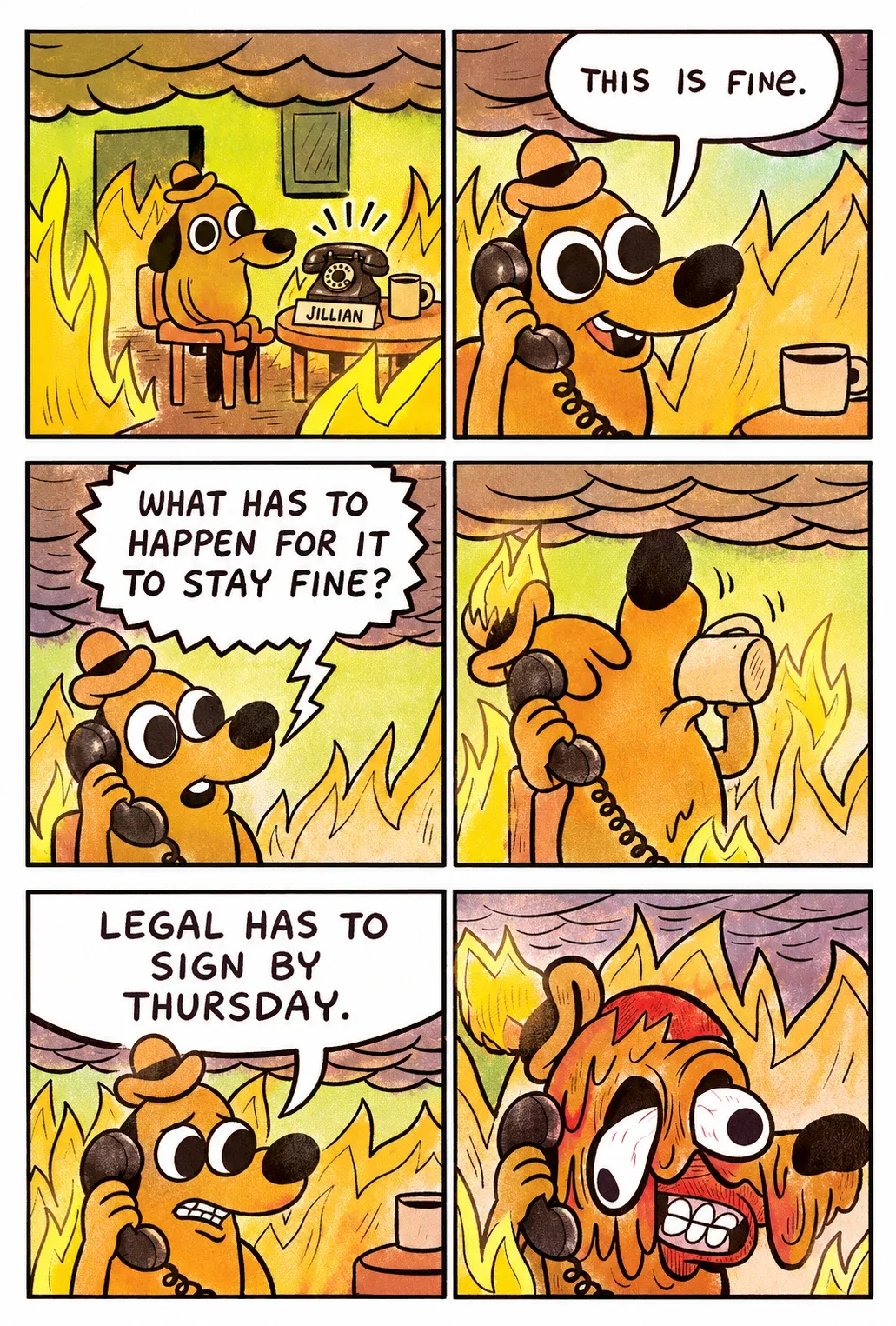
20 months - the average time between the first sign that a company needs to change and an actual change, according to a McKinsey study.
Twenty. Months.
For a startup, that can be most of the runway.
Those early signals of change rarely arrive with a siren. They sound more like, “Looks good, but we’re still waiting on Sales,” or “I think we can make the date, if Legal signs off.” Two people keep the workload “manageable” by working weekends. By the time the update reaches leadership, the but and the if have vanished. All that’s left is “everything’s fine.”
Let’s look at why good news travels faster than bad, why status reports are overrated, and how to catch a warning while there’s still time to act.
Why status reports are overrated
Status reports fit a template. Real problems don’t. You get a green box and “on track.” You don’t get the part where Legal hasn’t signed, Sales promised a date Product can’t meet, or two people worked all weekend to keep that box green. Monday’s report can be old news by Tuesday.
Here’s the uncomfortable part. In a 2026 field study at one consulting firm, employees rated work topics in a short survey, then talked them through with an AI interviewer. In 18 of 44 first interviews (41%), someone gave a positive rating and then raised a real concern about the same topic.
Asking “So what’s really going on?” isn’t enough. People edit themselves. They don’t want to get a colleague in trouble or raise a problem that will go nowhere. Ask a better question: “What has to happen for this to stay on track?”
Three reasons a warning gets smaller
A warning rarely vanishes all at once. It gets smaller on its way up. Here are three ways that happens.

These reasons can pile up. Someone can trust their manager and still avoid blaming another team. Someone else may feel safe but know from experience that nothing changes.
1. Saying it has a social cost
The manager knows the launch date won’t hold. But saying so means challenging the founder, disappointing a colleague, or looking unable to deliver. So the update becomes:
"We're making progress. There are a few dependencies to work through."
That sounds reasonable. But does “a few dependencies” mean routine work or a decision needed today? Leadership can’t tell.
There’s a name for the urge to soften bad news: the MUM effect. Rosen and Tesser described it in 1970. In interviews with 40 employees, Milliken and colleagues heard why people hold back: they fear looking bad or damaging a relationship. The 2026 study found caution even when people spoke. They softened concerns, avoided naming a leader, or stopped short of saying what might happen.
2. Speaking up seems pointless
Picture three teams asking for the same pricing decision. Each time, someone promises to follow up. No owner. No date. By the fourth meeting, “We need a decision” has become “We’re working through pricing.”
The team has learned what happens when it speaks up.
“Just speak up more” won’t fix it. A meta-analysis and six-month study found that speaking up and staying quiet are partly different habits. You can offer ideas all day and still hide one serious problem. People speak up more when they expect it to matter. They stay quiet when it feels unsafe.
The loudest person in the meeting may still be holding back the one thing you need to hear.
The 2026 paper points in the same direction, with a caveat: people may say more when they know who sees their answer and see that someone responds.
3. The format squeezes out the "if"
A color or a 1–5 rating gives you a quick answer. It has no room for the “if” behind it.
Someone may agree that their workload is sustainable because this month’s work will get done. Then they tell you it takes late nights and a colleague doing two jobs. Both answers can be true. Only one shows how close the plan is to breaking.
What a green RAG status can't tell you
Red, amber, green (RAG) tells you how someone sees the work right now. It doesn’t tell you what has to happen to keep it green. Watch how one issue changes as you ask more.

The goal is to find the dependency while you still have time to fix it.
The 2026 study compared each person’s rating and conversation about the same topic, minutes apart. It doesn’t prove that one answer was “true” and the other false. It shows that a score and a conversation can reveal different parts of the same problem.
How to move from firefighting to early alignment checks
Most leaders hear about a problem after it becomes a fire: a missed date, an angry customer, a team building the wrong thing. You can’t prevent every fire. You can hear about the smoke sooner.
Ask about the work, not the person’s confidence. “Are we on track?” invites a verdict. Try:
- What has to happen for this date to hold?
- Which part depends on another team's decision?
- What would make you change this status next week?
Don’t punish the messenger. A missing decision is a problem to solve, not a mark against the person who raised it.
Close the loop. Name who will decide, by when, and who needs the answer. If you can’t fix the issue, explain why. People are more likely to raise the next warning when they see you take this one seriously.
Run the same check every week. Listen for four things: teams with different priorities, dependencies with no owner, decisions stuck for weeks, and promises that keep moving to next week. Do this regularly and you’ll see drift before the deadline slips.
Decided helps SaaS companies with roughly 100 to 1,000 employees spot where work is drifting from the plan. Jillian, its AI interviewer, checks in one-to-one with leaders, managers, and key employees. She asks what they’re working on, what’s blocked, what changed, and what decision they need.
If someone says a launch is on track, Jillian asks what that depends on. If there’s a blocker, she asks who can clear it and when.
That comparison matters. One blocker may look small. Then three teams name it, or describe the same priority in three different ways. Now leadership can see the problem before the deadline slips.
The test for leadership
“Everything’s fine” can hide one condition that could break the plan. The earlier you hear it, the more you can do about it.
So ask yourself: would you hear about Thursday’s Legal deadline on Monday, or on Friday? Or let Jillian ask (just saying).
Frequently asked questions
Why do employees say "on track" when there's a problem?
Usually, they aren’t trying to mislead you. “On track” may mean “on track if Legal signs.” A status field has no room for that condition. People also soften concerns when speaking up feels risky or pointless. Ask what must happen for the plan to hold.
What software helps a team move from reactive firefighting to proactive alignment checks?
Look for software that asks about the work regularly, follows up when someone says “on track,” and compares answers across teams. Decided uses private voice check-ins with Jillian, then gives leaders a weekly brief of blockers, conflicting priorities, and decisions that need an owner.
How can a COO see where execution is drifting from the plan?
Every week, compare what teams call the priority. Look for dependencies with no owner, decisions still waiting, and dates that keep moving. Decided gathers these signals in check-ins and compares them with leadership’s plan.
Are there AI tools that can spot misalignment between what teams say and company strategy?
Yes. Jillian asks leaders and managers what they’re doing, what’s blocked, and what needs a decision. Decided compares their reviewed answers with the company’s priorities and with each other. People check the context and make the call.
Can you measure how much leadership indecision slows execution?
You can’t put an exact price on every delayed decision. But you can count the work waiting on one: how many items, which teams, who owns the call, and how long it has been open. Decided tracks those decisions with an owner and a date.
How can directors spot alignment gaps in their org before they escalate?
Ask managers separately what the current priority means for their next decision. Then compare their answers. If teams are taking different actions, the gap is real. Decided runs these check-ins regularly and shows where answers diverge.
Research discussed: Tamme and colleagues, Positive Ratings, Hidden Concerns (2026 conference preprint, accepted for HICSS-60); Sherf, Parke, and Isaakyan, Distinguishing Voice and Silence at Work (2021); Milliken, Morrison, and Hewlin, An Exploratory Study of Employee Silence (2003); Rosen and Tesser, On Reluctance to Communicate Undesirable Information: The MUM Effect (Sociometry, 1970). The examples and three-reason model are Decided's editorial explanations, not findings or customer results from these studies.